| |
|
|
Introduction Abdominal pain is one of the most common
symptoms of various diseases of the abdominal cavity or diseases
outside of it. It represents a great diagnostic challenge for both
primary healthcare physicians and clinical specialists. The cause is
very often completely benign, but it can also be a life-threatening
condition that must be recognized early and appropriate measures
taken. A precise history and detailed clinical examination are key
and indispensable parts of the diagnostic process, as they determine
the level of urgency and the scope of further consideration. We must
be particularly cautious in the treatment of the elderly, women of
reproductive age, and immunocompromised individuals, because the
clinical picture of otherwise common diseases can be atypical, and
at the same time we must also consider rarer and specific causes of
abdominal pain. In these groups, abdominal pain can be acute,
subacute, or chronic. The cause can be organic, but when the cause
cannot be identified despite extensive diagnostics, we speak of
functional abdominal pain syndrome. Depending on pathophysiological
mechanisms, we distinguish visceral, somatic, and referred pain. Due
to the specificity of treatment, a special entity is the so-called
acute abdomen, which is a life-threatening condition and requires
urgent treatment.
Abdominal pain is classified as acute or chronic based on an
arbitrary time frame of approximately 12 weeks. Establishing a
differential diagnosis is very complex and requires a thorough
history and comprehensive physical examination. However, the cause
remains unknown in 30% of cases [1].
It is necessary to analyze abdominal pain with special emphasis on
six characteristics: onset, progression, migration, character,
intensity, and localization. The onset of pain
The onset of pain can be: sudden, rapid, and gradual. Sudden pain
occurs in a second; typical for perforation of a peptic ulcer,
rupture of an ectopic pregnancy, mesenteric infarction, aneurysm
rupture. Rapid onset of pain – develops over several minutes; seen
in cholecystitis, pancreatitis, obstruction, appendicitis, ureteral
stone. Gradual onset is characterized by intensification of pain
over hours or days; more common in tumors, chronic inflammation, and
colon obstruction.
Progression
It is important whether the pain intensifies, decreases, or
transitions from intermittent to constant. For example, a perforated
ulcer can give severe initial pain that decreases if the perforation
closes, while intermittent pain that becomes constant indicates
obstruction with a risk of necrosis.
Migration of pain
Movement of pain from the site of origin is typical, for example,
for acute appendicitis (from the epigastrium or periumbilical area,
pain later moves to the right lower quadrant).
Character of pain
Abdominal pain can be characterized as crampy, dull, or sharp and as
constant or intermittent. Crampy pain (colic) follows a pattern of
waves that repeat at intervals — it suddenly intensifies to an
unbearable peak, then subsides or completely disappears for a time.
The most typical examples of colic in medical practice are renal
colic and biliary colic. Colicky pain is also associated with
mechanical obstruction of the small intestine and, when clearly
present, is highly suggestive of that condition. Constant dull or
sharp abdominal pain is usually caused by stretching or edema of the
wall of a hollow organ. When a hollow organ, such as the
gallbladder, becomes distended, which is most often the case due to
obstruction of the cystic duct, constant, dull pain occurs. When the
gallbladder contracts due to obstruction, the stretching of the
gallbladder wall suddenly intensifies, creating crescendo pain (biliary
colic), in addition to the already present constant dull pain.
Sharp (stabbing) pain is usually well localized (the patient can
point with a finger where it hurts). It is usually sudden and very
intense. It often indicates irritation of the peritoneum; it occurs
in the late phase of appendicitis in the lower right part of the
abdomen when every movement, cough, or pressure on that spot causes
"stabbing." Sharp pain like a "knife stab" is also characteristic of
ulcer perforation. Dull pain is more difficult to precisely locate.
Patients describe it as a feeling of pressure, heaviness, or
"squeezing" in the stomach. It usually comes from internal organs,
most often as a result of irritation of the capsule of an enlarged
liver or spleen, which patients describe as persistent, nagging,
dull pain below the right or left rib arch.
Intensity of pain
The intensity of pain in an individual patient can often be assessed
by the way the patient physically reacts to it. In somatic pain due
to peritonitis, the patient is still, lies motionless with legs
bent. In visceral pain, for example in cholecystolithiasis or
nephrolithiasis, the patient is restless, changes positions, tries
to alleviate the symptoms himself.
Localization
Localization can indicate the origin and pathological basis of pain.
Visceral pain is generally poorly localized, in the middle zones of
the abdomen; often accompanied by nausea, vomiting, pallor,
sweating. Somatic pain is well localized, intensifies with pressure,
breathing, and movement; usually without vegetative symptoms [2].
Epidemiology
Abdominal pain is the cause of 5-10% of all visits to emergency
medicine clinics.
From 50 to 75% of people older than 65 years with acute abdominal
pain require hospitalization, and 1/3 of them require surgical
intervention. In patients older than 65 years, compared to younger
patients, mortality is 6 to 8 times higher. In 25% of patients who
leave the emergency medicine clinic and even 35-41% of patients
hospitalized due to abdominal pain, the cause remains undetermined.
In 80% of patients with unexplained cause of abdominal pain, the
pain usually subsides spontaneously within two weeks from the onset
[3].
Pathophysiology
Based on origin, pain can be: nociceptive - tissue damage,
neuropathic - nerve damage, and psychogenic - predominantly
psychological. Given the multitude of diseases that can manifest
with this symptom, accurate interpretation of abdominal pain
represents a great challenge for the physician, requiring not only
theoretical knowledge but also extensive practical experience.
Depending on pathophysiological mechanisms, abdominal pain can be
divided into visceral, somatic (parietal), and referred [4]. Sensory
pain receptors or nociceptors are located in the mucosa, muscle
layers of hollow organs of the gastrointestinal tract (GIT), and
mesentery. Nociceptors are peripheral endings of myelinated A delta
nerve fibers and unmyelinated C fibers.
Visceral pain arises from stimulation of free nerve endings in
visceral organs and is transmitted by slow C fibers originating from
the wall of hollow organs, mesentery, and capsule of solid organs.
The fibers enter the spinal cord bilaterally and at several levels,
so visceral pain is poorly circumscribed. The pain can be dull,
sharp, or crampy in character. It does not depend on breathing or
body position, but can be characterized by radiation to adjacent
parts of the body and the presence of other visceral symptoms such
as nausea, vomiting, and loss of appetite. Visceral pain is caused
by ischemia, inflammation, or stretching of hollow organs or the
capsule of solid organs. The most characteristic visceral pain is
colic, which arises from excessive contraction of the muscle of a
hollow organ during obstruction (e.g., colic due to stone in the
urinary or biliary tract). The moment when dull, diffuse pain
transitions into clearly localized pain marks the spread of the
pathological process from the visceral to the parietal peritoneum.
Somatic pain is transmitted by fast A fibers to the dorsal ganglia
of the spinal cord on the side of the source of the painful stimulus
and the corresponding dermatome, so this pain is well circumscribed.
By nature, it is sharp and constant, depends on breathing and body
position.
It is characteristic that muscle defense and skin hyperesthesia
above the affected part of the peritoneum can occur. This is the
result of direct irritation of the parietal peritoneum due to
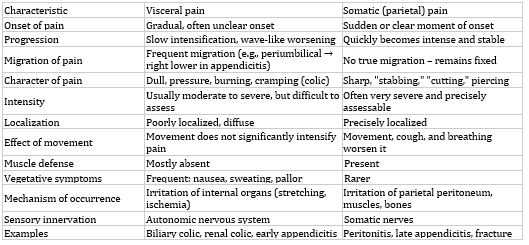
ischemia, inflammation, or stretching [5]. Table 1 shows the
characteristics of visceral and somatic pain.
Table 1. Comparative characteristics of visceral
and somatic pain
Referred pain is well-localized pain that is distant from the
affected organ. It is felt in the skin dermatomes of somatic
afferent nerves that enter the spinal cord at the same level as the
visceral afferent fibers of the affected organ. It is pain felt at a
site that is not the actual source of pain. It arises due to shared
nerve innervation of the internal organ and the skin.
Practically, the brain "mislocalizes" the pain. Sometimes referred
pain can be triggered or intensified by palpation of the affected
organ. Pressure on the skin at the site where referred pain is felt
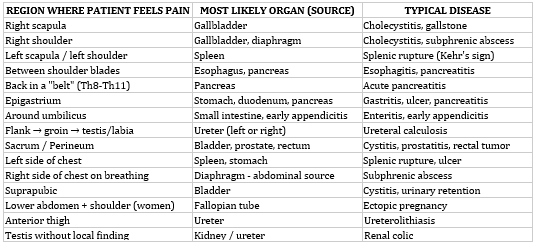
usually does not change the intensity of pain [6]. The referral of
pain from abdominal organs to other regions is so characteristic
that from this referral one can conclude which organ is affected
(Table 2).
Table 2. Correlation of localization of referred
pain, potential source, and typical diseases
DURATION OF PAIN
Depending on the time course, we distinguish acute, subacute, and
chronic pain.
Acute abdominal pain can appear suddenly or develop over days or
even weeks (subacute pain). It is usually constant, less often
intermittent, with possible worsenings and improvements. It is one
of the most common gastrointestinal symptoms and accounts for 5% of
all emergency room visits. In 25-50% of patients, the cause of acute
abdominal pain cannot be found. The most commonly identified causes
are acute appendicitis, intestinal obstruction, diseases of the
gallbladder and biliary tract, diseases of the urinary tract,
intestinal diverticula, and acute pancreatitis. In women of
reproductive age, we must always consider gynecological causes of
abdominal pain [7].
We speak of chronic abdominal pain when it lasts at least 6 months.
It can be constant or intermittent. Chronic abdominal pain is the
reason for 25-50% of all visits to gastroenterology offices. The
most common cause of chronic abdominal pain are functional
gastrointestinal disorders such as irritable bowel syndrome,
functional dyspepsia, and functional biliary pain. Chronic abdominal
pain resulting from organic diseases is most often caused by chronic
inflammatory bowel diseases, peptic ulcers of the stomach and
duodenum, celiac disease, adhesions, chronic inflammation of the
pancreas, and neoplasms. Chronic pain associated with defecation
occurs in irritable bowel syndrome, chronic postprandial pain in
functional dyspepsia and chronic mesenteric ischemia, and chronic
pain associated with the menstrual cycle in endometriosis and other
gynecological diseases [8].
Functional abdominal pain syndrome belongs to the group of
functional gastrointestinal disorders, which are diagnostically
defined by the Rome criteria (Roma IV: CAPS - centrally mediated
abdominal pain syndrome). Despite extensive
Acute abdomen is a synonym for sudden diseases of abdominal organs,
characterized by severe abdominal pain, nausea with or without
vomiting, signs of peritoneal irritation, and more or less
pronounced general impairment. Due to the urgency of the condition,
often only a rough definition of the disease is possible, but not a
reliable and final diagnosis. The necessity of therapeutic action
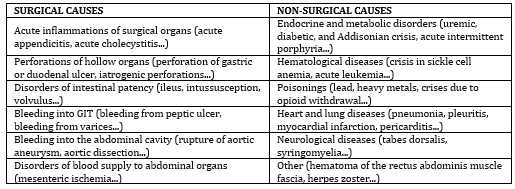
thus prevails over a more precise diagnosis. Causes of acute
abdominal pain can be surgical or non-surgical (Table 3)
Table 3: Surgical and non-surgical causes of acute
abdomen
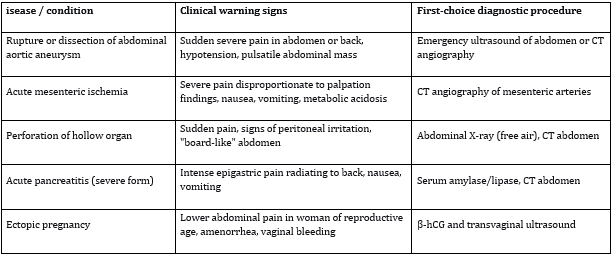
In the initial assessment of a patient with abdominal pain, it is
particularly important to timely recognize potentially
life-threatening conditions, as shown in Table 4.
Table 4. Five potentially life-threatening causes
of abdominal pain
EVALUATION OF THE PATIENT WITH ABDOMINAL PAIN
History
A thorough history and systematic clinical examination represent the
foundation of the diagnostic approach to a patient with abdominal
pain and determine the rational choice of laboratory and imaging
tests. In a significant number of patients, the diagnosis can be
made based on clinical assessment alone, while in a smaller
proportion of patients the cause remains unclear despite extensive
diagnostics.
Although abdominal pain is most often a consequence of
gastrointestinal diseases, extra-abdominal causes (cardiovascular,
respiratory, metabolic, urological, and gynecological) should always
be considered in the differential diagnosis. Early recognition of
life-threatening conditions has particular priority, because the
time interval from the appearance of symptoms to adequate
therapeutic intervention is directly related to the treatment
outcome.
Demographic data (age and sex), comorbidities, previous surgeries
and hospitalizations, current therapy, allergies, lifestyle habits,
and family history significantly guide differential-diagnostic
reasoning.
Analysis of pain must be systematic and include: localization,
onset, progression, duration, intensity, character, migration, and
irradiation, as well as factors that provoke or alleviate the pain.
It is necessary to actively inquire about accompanying symptoms:
nausea, vomiting, diarrhea or constipation, weight loss, fever,
jaundice, dyspnea, chest pain, palpitations, as well as urogenital
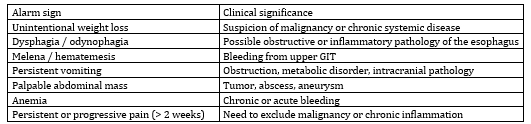
complaints. In patients with abdominal pain, it is important to
recognize the so-called "Red Flags," i.e., alarm symptoms, which
indicate potentially life-threatening conditions and require urgent
diagnostics [10]. The significance of alarm symptoms is shown in
Table 5.
Table 5. Alarm signs and clinical significance
Special categories of patients require increased clinical
caution:
Elderly patients – often have an atypical, sparse, or masked
clinical picture.
Women of reproductive age – pregnancy and its complications
must be excluded.
Immunocompromised – increased risk of opportunistic
infections and malignancies.
Clinical examination
Assessment begins already at the first contact with the patient –
general appearance, body position, level of consciousness, and
orientation often indicate the severity of the condition. Vital
parameters (blood pressure, pulse, respiratory rate, temperature,
oxygen saturation) enable rapid assessment of hemodynamic and
respiratory stability. In patients with vomiting, diarrhea, fever,
or bleeding, assessment of hydration status is necessary.
Abdominal examination includes:
Inspection - Assessment of the shape and symmetry of the
abdomen, distension, postoperative scars, skin changes, and visible
masses.
Palpation - Performed systematically, starting away from the
site of greatest tenderness. Superficial palpation is performed
first, then deep palpation. The following are assessed:
- local tenderness
- muscle defense
- rebound tenderness
- presence of palpable masses
Muscle defense represents a sign of irritation of the parietal
peritoneum and is most pronounced in perforations of gastroduodenal
ulcer (chemical peritonitis). It is milder in inflammatory
processes, while in intraperitoneal bleeding it may be discrete. In
bleeding into the lumen of the digestive tract, defense is absent.
Percussion - Used to assess free fluid and
pneumoperitoneum.
Auscultation - Assessment of peristalsis and possible
vascular murmurs.
Rectal examination is an integral part of the evaluation.
Gynecological or urological examination is performed as indicated
[2].
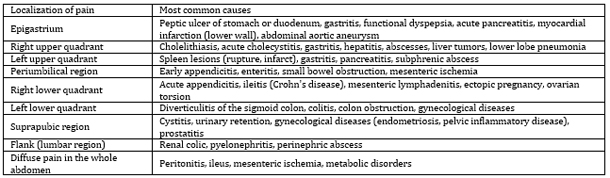
Typical clinical signs that help in establishing the diagnosis are
shown in Table 6, and the localization of the most common causes of
abdominal pain in Table 7.
Table 6. Typical clinical signs that help in
establishing the diagnosis
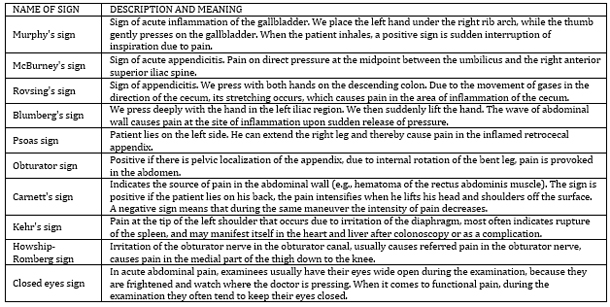
Table 7. Most common causes of abdominal pain by
localization
Laboratory diagnostics
The basic laboratory panel includes:
- complete blood count with differential
- electrolytes and kidney function
- glycemia
- liver function tests
- amylase and lipase
- inflammation parameters
- urinalysis
Based on clinical indication, the following are determined:
- troponin (suspicion of acute coronary syndrome)
- D-dimer (suspicion of pulmonary embolism)
- blood gases and lactate (suspicion of ischemia or sepsis)
- pregnancy test is mandatory for women of reproductive age
Tumor markers have no role in the initial diagnosis of abdominal
pain due to insufficient sensitivity and specificity, but serve for
monitoring already diagnosed malignant disease [3].
Imaging diagnostics
The choice of method depends on the clinical suspicion:
- Native abdominal X-ray – pneumoperitoneum, ileus.
- Abdominal ultrasound – pathology of the gallbladder, urinary
tract, gynecological diseases, assessment of the abdominal aorta.
- CT abdomen with contrast – perforations, abscesses, malignancies,
complicated inflammatory diseases.
In case of suspicion of thoracic etiology, a chest X-ray or
echocardiography is indicated.
Endoscopic procedures have a diagnostic, and often therapeutic role.
TREATMENT OF PATIENTS WITH ABDOMINAL PAIN
The Latin saying "Dolorem sedare, medici divinum opus est"
emphasizes the basic principle of medical practice – alleviating
pain represents not only a therapeutic but also an ethical
obligation of the physician.
The therapeutic approach to a patient with acute abdominal pain can
be:
- Causal (etiological) – directed at the underlying disease.
- Symptomatic (supportive) – directed at stabilizing vital functions
and controlling symptoms.
In urgent conditions, initial stabilization of the patient has
priority (principles of the ABC approach), in parallel with
diagnostic evaluation.
Supportive treatment
Supportive measures include:
- fluid and electrolyte replacement (oral or parenteral)
- hemodynamic support (vasopressors and inotropes as indicated)
- analgesic therapy
- antiemetic therapy
- oxygen therapy
- correction of metabolic disorders
In case of suspicion of an acute surgical condition, timely
consultation with an abdominal surgeon is necessary [11].
Analgesic therapy
Modern data indicate that the use of opioid analgesics in acute
abdominal pain does not reduce the diagnostic value of the clinical
examination, nor does it negatively affect the treatment outcome.
Therefore, adequate analgesia should not be delayed for fear of
"masking" the clinical picture.
The choice of analgesic depends on the intensity of pain and the
general condition of the patient and may include:
- nonsteroidal anti-inflammatory drugs
- opioids
- spasmolytics
Long-term use of opioids in chronic or functional abdominal pain is
not recommended due to the risk of dependence and opioid-induced
hyperalgesia.
Treatment of functional pain
In situations where, after adequate diagnostic evaluation, no
organic cause of pain is established, a functional or centrally
conditioned etiology is considered. In such cases, the following may
be indicated:
- psychological or psychiatric evaluation
- use of tricyclic antidepressants (TCA)
- selective serotonin reuptake inhibitors (SSRI)
- serotonin and norepinephrine reuptake inhibitors (SNRI)
These drugs act through modulation of central pain perception,
independent of their antidepressant effect [12].
Rational use of antibiotics
Empirical use of antibiotics in patients with abdominal pain must be
clearly indicated and based on clinical suspicion of bacterial
infection or intra-abdominal inflammatory process. Routine use of
antibiotics in undifferentiated abdominal pain is not justified.
Antibiotic therapy is indicated in:
- suspicion of intra-abdominal infection (e.g., perforation of
hollow organ, abscess, complicated diverticulitis)
- acute cholangitis
- peritonitis
- septic condition of unclear abdominal origin
- severe forms of pancreatitis with evidence of infection
immunocompromised patients with a clinical picture of infection
The choice of antibiotic should cover the most common causes of
intra-abdominal infections (Gram-negative enterobacteria,
anaerobes), taking into account local resistance patterns and
individual risk factors.
Therapy should be:
- timely (especially in case of septic shock),
- adequately dosed,
- time-limited in accordance with clinical response.
Prolonged or inadequate use of antibiotics increases the risk of
developing resistance, Clostridioides difficile infection, and other
complications, so regular re-evaluation of the need for continued
therapy is recommended [13].
Patients at increased risk of unfavorable outcome
Increased morbidity and mortality are expected in:
- patients older than 65 years
- immunocompromised
- polymorbid patients
- patients after abdominal operations or recent endoscopic
procedures
- pregnant women (especially in the first trimester)
- patients with sudden onset of severe, constant pain
- patients with signs of peritonitis or hemodynamic instability
Indications for hospitalization
Hospital treatment is indicated in patients with:
- suspicion of peritonitis
- obstruction or perforation of the intestine
- acute intra-abdominal or gastrointestinal bleeding
- hemodynamic instability
- uncontrolled pain despite adequate oral therapy
- need for parenteral therapy or invasive supportive measures [14]
CONCLUSION
A patient with abdominal pain represents a diagnostic challenge
that requires a systematic, rational, and time-efficient approach
due to the extensive differential diagnosis, which includes both
harmless pathological processes and many that threaten life. The
foundation of the evaluation is a carefully taken history and a
detailed clinical examination, which guide further laboratory and
imaging diagnostics. Early recognition of life-threatening
conditions, adequate risk assessment, and timely consultation with a
surgeon or attending physician are of crucial importance for the
treatment outcome.
Monitoring and treatment of patients with functional
gastrointestinal diseases today represents an increasing challenge.
Supportive measures and analgesia should not be delayed, while
etiological therapy is carried out purposefully, in accordance with
the established and probable diagnosis.
Rational use of antibiotics and avoidance of unnecessary therapy
represent an important part of modern clinical practice. By
integrating clinical experience, diagnostic tools, and a
multidisciplinary approach, it is possible to optimize the
management of patients and reduce morbidity and mortality associated
with abdominal pain.
Literature:
- Tintinalli JE, Kelen GD, Stapczynski JS, editors.
Tintinalli's emergency medicine: a comprehensive study guide.
6th ed. New York: McGraw-Hill; 2004.
- Sherman R. Abdominal pain. In: Walker HK, Hall WD, Hurst JW,
editors. Clinical methods: the history, physical, and laboratory
examinations. 3rd ed. Boston: Butterworths; 1990. Available
from: https://www.ncbi.nlm.nih.gov/books/NBK412/ [Accessed 2026
Feb 4].
- Turk Jerovšek M, Štepec S. Bolečina v trebuhu.
Gastroenterolog. 2018;(Suppl 3):68-74.
- Silen W. Principles of diagnosis in acute abdominal disease.
In: Silen W. Cope's early diagnosis of the acute abdomen. 22nd
ed. Oxford: Oxford University Press; 2010. p. 3-8.
- Allen S, Wallis DC. Acute abdominal pain. InnovAiT.
2024;17(1):39-48. doi:10.1177/17557380231210162.
- Jin Q, Chang Y, Lu C, Chen L, Wang Y. Referred pain:
characteristics, possible mechanisms, and clinical management.
Front Neurol. 2023;14:1104817. doi:10.3389/fneur.2023.1104817.
- Kopitnik NL, Kashyap S, Dominique E. Acute abdomen. In:
StatPearls [Internet]. Treasure Island (FL): StatPearls
Publishing; 2026. Available from:
https://www.ncbi.nlm.nih.gov/books/NBK459328/
- Potack ZJ. Approach to abdominal pain. In: Sands BE, editor.
Mount Sinai Expert Guides: Gastroenterology. 1st ed. Oxford:
John Wiley & Sons; 2015. p. 21-30.
- McClellan N, Ahlawat R. Functional abdominal pain in
children. In: StatPearls [Internet].Treasure Island (FL):
StatPearls Publishing; 2026. Available from:
https://www.ncbi.nlm.nih.gov/books/NBK537298/
- Gijsbers CF, Benninga MA, Schweizer JJ, Kneepkens CM,
Vergouwe Y, Büller HA. Validation of the Rome III criteria and
alarm symptoms for recurrent abdominal pain in children. J
Pediatr Gastroenterol Nutr. 2014;58(6):779-785.
- Jovanović M, Jović M, Jolić A. Diferencijalna dijagnoza
abdominalnog bola u prehospitalnim uslovima. Timočki Med Glas.
2006;31(3):102-115.
- Chakraborty PS, Daniel R, Navarro FA. Non-pharmacologic
approaches to treatment of pediatric functional abdominal pain
disorders. Front Pediatr. 2023;11:1118874.
doi:10.3389/fped.2023.1118874.
- Di Stefano M, Fasulo R, Corazza GR. Rational use of
antibiotics in the treatment of functional bowel disorders.
Pharmaceuticals (Basel). 2010;3(8):2380-2386.
doi:10.3390/ph3082380.
- Macaluso CR, McNamara RM. Evaluation and management of acute
abdominal pain in the emergency department. Int J Gen Med.
2012;5:789-797. doi:10.2147/IJGM.S25936.
|
|
|
|