|
||||||||||||||||||||||||||||||||||||
| [
Contents
] [ INDEX ]
|
||||||||||||||||||||||||||||||||||||
|
Review article PSYCHOSOCIAL ADAPTATION IN PATIENTS WITH COLOSTOMY: A LITERATURE REVIEW Srđan Petković (1), Mihailo Bezmarević (2,3), Boško Milev (2,3), Milan Jovanović (2,3) (1) DEPARTMENT OF SURGICAL DISEASES, MILITARY HOSPITAL NOVI SAD, NOVI SAD, SERBIA (2); CLINIC FOR GENERAL SURGERY, MILITARY MEDICAL ACADEMY, BELGRADE, SERBIA; (3) FACULTY OF MEDICINE, UNIVERSITY OF DEFENCE, BELGRADE, SERBIA |
||||||||||||||||||||||||||||||||||||
|
|
||||||||||||||||||||||||||||||||||||
| Download in pdf format | Summary: Colostomy,
a surgical procedure most commonly performed due to colorectal
cancer, inflammatory bowel disease or trauma, causes significant
changes in patients’ physical, emotional and social functioning. The
aim of this review was to synthesize the existing literature on
psychosocial adaptation after colostomy creation, identify key
influencing factors, challenges and possible interventions. A search
was conducted in PubMed, Scopus, Google Scholar and PMC using
keywords related to psychosocial adaptation and quality of life in
stoma patients (1995–2025). The literature indicates a high
prevalence of anxiety and depression (30–50%) in the first months
after surgery, as well as issues with body image, social isolation
and sexual dysfunction. Key factors for successful adaptation
include social and family support, disability acceptance, time since
surgery and early education. A multidisciplinary approach involving
support groups and psychological counseling significantly improves
outcomes. The lack of local studies in Serbia highlights the need
for further research in our context. Keywords: colostomy, ostomy, psychosocial adaptation, quality of life, social support. |
|||||||||||||||||||||||||||||||||||
|
INTRODUCTION Colostomy represents a surgical intervention
in which an artificial opening is created on the abdominal wall for
the elimination of digestive waste products. It most commonly
results from the treatment of colorectal cancer, inflammatory bowel
diseases (Crohn’s disease or ulcerative colitis), or trauma [1]. The
procedure for creating a colostomy can be temporary or permanent. It
is estimated that more than 100,000 colostomies are performed
annually in Europe and North America, with a growing number of
patients surviving the underlying disease owing to advances in
oncology and surgery [1]. Although colostomy, as part of emergency
or elective surgical procedures, saves lives, it leads to
significant changes in patients’ daily functioning, which can
substantially affect their physical, emotional, and social
well-being [2]. Methods For this literature review, a comprehensive search of the
available literature was conducted to identify relevant sources on
the psychosocial adaptation of patients following colostomy
creation. The following databases were searched: PubMed, Scopus,
Google Scholar, and PubMed Central (PMC). These databases were
selected because they provide extensive coverage of both medical and
psychosocial literature and offer substantial open-access resources. Results The literature review identified numerous studies addressing the psychosocial aspects of life in patients with colostomy. The findings were synthesized thematically into the following domains: psychological aspects, social aspects, sexual and intimacy-related issues, factors influencing adaptation, and implemented interventions. Psychological aspects Psychological problems are among the most common challenges faced by patients with colostomy, with the prevalence of anxiety and depression reaching 30–50% in the first months after surgery [1,7,8]. The literature highlights that patients frequently experience a sense of loss of control over their body, leading to changes in body image perception, decreased self-confidence, and possible body dysmorphia [2,8,9]. For example, one review study noted that anxiety often arises from the fear of leakage or odor from the colostomy, which affects daily activities and contributes to social isolation [1]. Qualitative studies show that these symptoms tend to decrease over time but may persist in the absence of early intervention, particularly in patients with a permanent colostomy [4, 10]. Contradictions in the literature include cultural variations, where patients in Asian countries report higher levels of stigma compared to those in Western countries, which further exacerbates depression [3,11]. Additionally, older patients tend to demonstrate greater emotional resilience, whereas younger patients often experience a more intense sense of loss [5]. Social aspects Social isolation is a frequent problem, as many patients avoid
social contacts due to fear of stigmatization or practical
difficulties related to the colostomy [8,9,10]. Studies emphasize
the important role of family and social support in mitigating these
effects. Patients with a strong support network show better
adaptation and lower levels of loneliness [3,4,8]. Support groups,
such as those in stoma clinics, contribute to the normalization of
the experience through sharing personal stories, thereby reducing
social anxiety and improving social integration [6,7,12]. However,
some findings suggest that men more commonly experience social
isolation due to cultural expectations of strength and independence,
while women tend to make better use of social resources [5]. The
literature also indicates that lack of family support leads to
prolonged isolation, especially in rural areas with limited access
to healthcare services [3,9]. Factors influencing adaptation Several factors modulate the adaptation process, including time
since surgery (better adaptation after 1–2 years), gender (women
often adapt better socially, while men may adapt better
psychologically), and the level of perceived stigma [3,5,10].
Acceptance of disability has emerged as a key predictor, with
patients showing higher levels of acceptance demonstrating lower
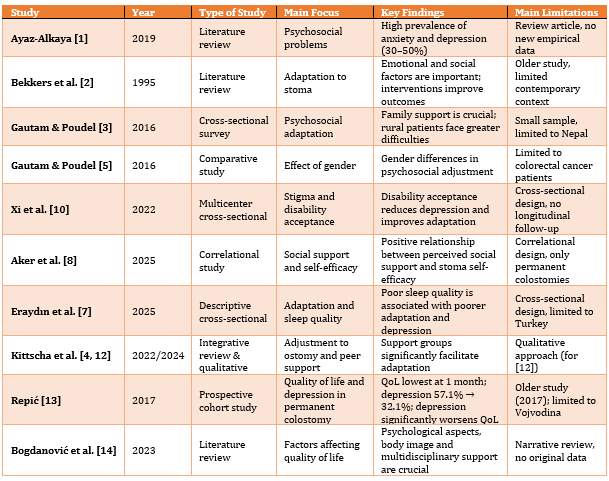
levels of depression and better quality of life [6,9,10]. Interventions Interventions primarily focus on education, psychological counseling, and support groups. Studies demonstrate that support groups significantly improve adaptation by enabling the sharing of experiences and practical advice, reducing anxiety by 20–30% [4,7,12]. Nurses play a crucial role in early education on colostomy management, which decreases anxiety and enhances patient autonomy [5,6]. A multidisciplinary approach, including psychologists and social workers, is recommended for holistic care, with an emphasis on individualized programs [1,8,9]. The effectiveness of these interventions varies, with better outcomes observed in structured programs; however, there are conflicting findings regarding their long-term efficacy without continuous support [2,9]. The literature suggests that the integration of technology, such as online support groups, may improve access to support, particularly in rural areas [3,10,11]. Table 1: Comparison of key findings from selected
Discussion The synthesized findings from the literature confirm that
psychosocial adaptation to colostomy is a complex, dynamic, and
multidimensional process encompassing emotional, social, and sexual
challenges. The early postoperative phase is also the most
difficult, characterized by high levels of anxiety, depression, and
body image disturbances, while patients’ quality of life and
autonomy gradually improve over time, particularly with adequate
support [1,4,10]. Conclusion Psychosocial adaptation in patients following colostomy creation
is a complex and dynamic process that involves emotional, social,
and sexual challenges. The early phase of adaptation is most often
characterized by high levels of anxiety, depression, and alterations
in body image perception. However, over time and with adequate
support, patients’ quality of life and autonomy significantly
improve. The key factors for successful adaptation include strong
social and family support, acceptance of the new condition, early
education, and participation in support groups. LITERATURE
|
||||||||||||||||||||||||||||||||||||
|
|
||||||||||||||||||||||||||||||||||||
| [
Contents
] [ INDEX ]
|
||||||||||||||||||||||||||||||||||||
|
||||||||||||||||||||||||||||||||||||